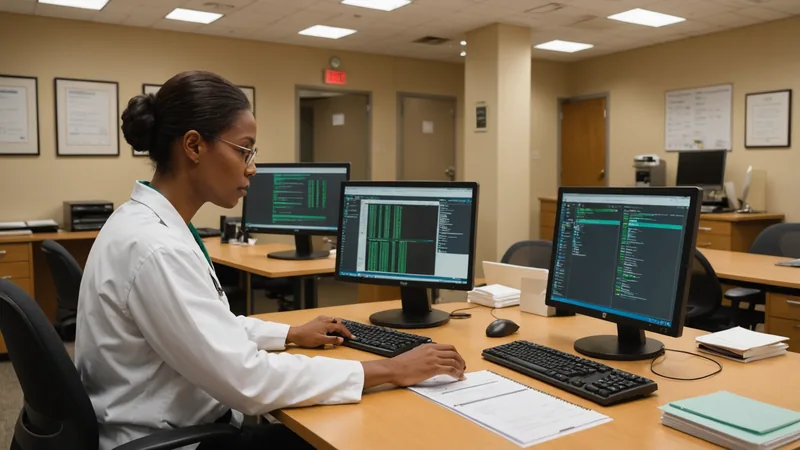
When I was still doing care coordination full-time, my morning started with a ritual that took anywhere from 45 minutes to an hour: pulling up three separate screens, cross-referencing the care management system against the EHR scheduling module and a PBM claims report that had been emailed to me as a spreadsheet the night before, and assembling a personal sense of who needed attention today. I knew which patients were post-discharge, which ones had overdue labs, and who had called the triage line the day before. I held a lot of that in my head because the tools didn't surface it clearly.
When I hear care coordinators express anxiety about automation, I understand it. The word "automation" in healthcare is usually attached to projects that promise to "optimize workflows" and end up adding a new system that nobody fully uses and that generates alerts at the wrong time for the wrong patients. That anxiety is earned. But it's also describing something different from what good workflow tooling actually does.
What Coordinators Actually Spend Time On
A care coordinator's day involves two fundamentally different categories of work. The first is the high-value clinical and relational work: calling a CHF patient who just got home from a five-day admission, reviewing their weight log with them, understanding that they can't afford the spironolactone out-of-pocket this month and helping them navigate the prior auth, building the trust over time that makes a patient actually call when they feel worse instead of waiting until they're in crisis. This work requires judgment, clinical training, and a human relationship. Nothing automates this well.
The second category is the infrastructure work that makes the first category possible: figuring out who needs the call, determining which of your 45 post-discharge patients is the highest priority this morning, identifying which patient's metformin ran out four days ago and nobody has noticed, confirming that the three appointment reminders from yesterday actually resulted in confirmations versus going to voicemail. This is the work where most coordinators spend 40 to 60 minutes of their morning — and it's the work that, done manually, is error-prone and inconsistent.
Automation's value in care coordination is almost entirely in category two. The goal isn't to replace the coordinator's judgment calls — it's to make the information that drives those judgment calls arrive faster, more completely, and already sorted by priority so the coordinator spends 10 minutes on morning prep instead of 60.
The Worklist Problem
Most care management platforms generate worklists. The problem is that these worklists are usually built on a calendar logic — patients appear because their scheduled follow-up is today, or because their HbA1c is overdue by 90 days — not because something changed yesterday that makes them the clinical priority right now. A coordinator who worked through her CHF post-discharge list yesterday comes in this morning to a list that shows the same patients in roughly the same order, with no indication that one of them didn't respond to yesterday's call and also hasn't filled their furosemide.
What a well-designed automated alert system does is re-sort that worklist based on what changed overnight: new ADT events, new pharmacy fill gaps, no-shows that weren't rescheduled, and outreach attempts that got no response after 48 hours. The coordinator sits down in the morning with a list that's already prioritized by signal recency and clinical urgency, not by the scheduling calendar.
This sounds simple, but it requires integrating data from multiple sources — the EHR, the PBM feed, the scheduling system, the outreach history — and doing it in near-real-time. Most health system care management platforms don't do this; they operate on overnight batch processing at best. The result is that coordinators compensate by doing the integration manually, which is what that 45-minute morning ritual was actually about.
Automation That Works vs. Automation That Doesn't
Automated patient outreach — SMS reminders, automated calls, portal messages — gets the most attention in discussions about care coordination automation. It can genuinely reduce coordinator workload for routine, low-acuity outreach: appointment reminders for stable patients, refill nudges for patients on maintenance medications who are approaching their refill window. These are interactions where the goal is a simple confirmation (yes, I'll be there; yes, I'm picking up my medication), not a clinical assessment.
Where automated outreach fails is when it's applied uniformly to patients who need a human conversation. A post-discharge CHF patient who should receive an automated SMS reminder for a stable annual wellness visit is a different clinical situation from a post-discharge CHF patient who is 72 hours out from an acute decompensation admission. Treating those the same — because both have a "follow-up" flag — is a category error that automated outreach tools make when the underlying risk stratification isn't granular enough to distinguish them.
We're not saying that all automated outreach is low-value. We're saying the value of automated outreach is entirely dependent on the quality of the risk signal that determines which patients receive it and which patients get escalated to a coordinator call instead. Automation without good signal selection adds noise; automation layered on accurate signal selection frees up the coordinator's time for the patients who actually need her.
What This Looks Like Day-to-Day
In an implementation I helped stand up with a growing regional primary care group managing a chronic disease population under a VBC contract, the workflow change that mattered most to the care coordinator team was specific: they stopped doing manual morning list-building. The system surfaced a prioritized alert queue each morning — post-discharge patients with unconfirmed pharmacy fills at the top, followed by patients with recent no-shows and no outreach response, followed by patients with pending HEDIS gaps approaching the Q3 window.
The coordinators still made all the clinical judgment calls. They decided when a patient needed a more intensive intervention, when to loop in the care team, when to escalate to a social worker for SDOH support. Those decisions didn't change. What changed was how much of their morning was consumed by figuring out who needed those calls, versus actually making them.
The coordinators in that group described it consistently: they were spending more time on the phone with patients and less time with spreadsheets. The administrative coordination burden — the data gathering, the cross-referencing, the prioritization — shifted to the system. The clinical and relational work, which is the work they trained for and which can't be automated well, stayed with them.
The Right Framing for Care Teams Evaluating Tools
If you're a VBC director or a care management program manager evaluating outreach and care gap tools, the question to ask isn't "how much work does this automate?" — it's "what does a coordinator's morning look like after this is implemented?" If the answer is "the system does the data gathering and prioritization, and the coordinator spends her time making calls," that's a tool designed around coordinator workflow. If the answer is "the system sends automated messages to patients and coordinators review exceptions," that's a different design philosophy with different failure modes.
The chronic disease population you're managing doesn't benefit from automation that reduces human contact — it benefits from automation that makes human contact more precisely targeted to the moments and patients where it matters most. The coordinator who can make 12 high-value calls in a morning because her prioritization work took 10 minutes instead of 60 is more effective than the coordinator who spends 45 minutes on prep and makes 7 calls. Not because she works harder — because the tool she has supports what she does, rather than adding to the administrative burden that keeps care coordinators from doing it.