Three components. One care coordinator queue. No EHR write-back required.
A disease-specific risk engine, a multi-channel outreach module, and a reporting dashboard designed for VBC care management — not generic health IT. Each piece built around how care coordinators actually work a panel.
See the platform in a demo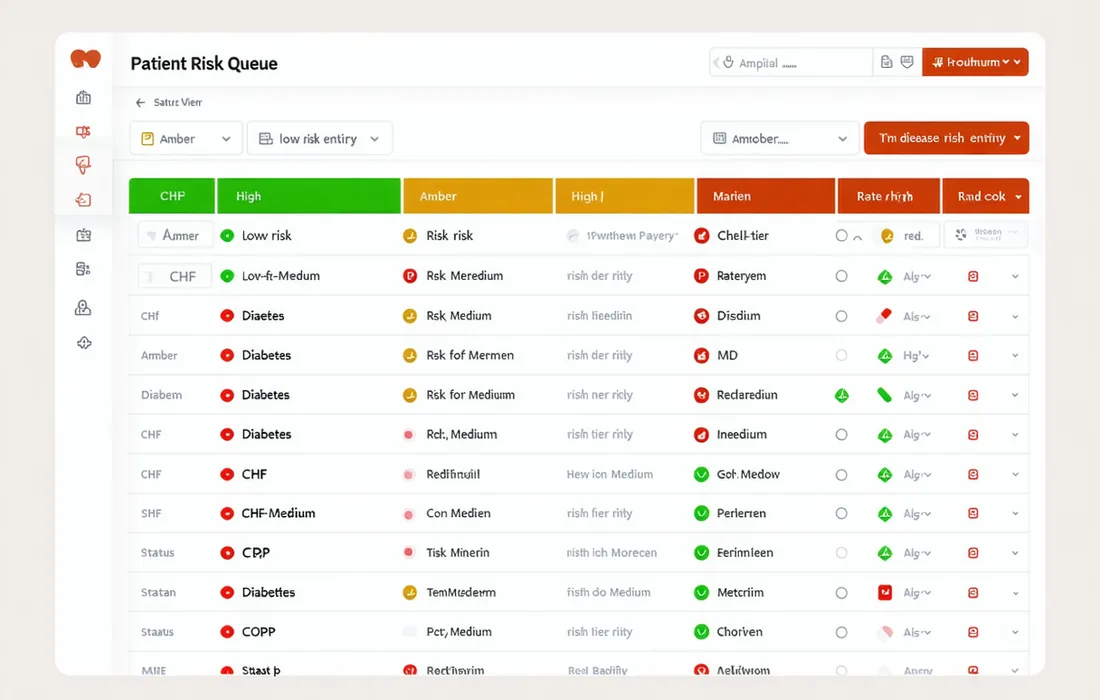
Four disease models. One ranked queue per care team.
Each chronic disease population gets its own risk model trained on disease-specific signals. The diabetes model weights Rx fill intervals and HbA1c visit cadence. The CHF model weights post-discharge pharmacy timing and beta-blocker refill gaps. Generic models lose signal — population-specific models surface the right patients at the right time.
The output is a single ranked queue per care team, ordered by intervention urgency. Coordinators don't need to look at four separate disease lists — the system sorts by who needs to be called today, with the reason surfaced next to each patient.
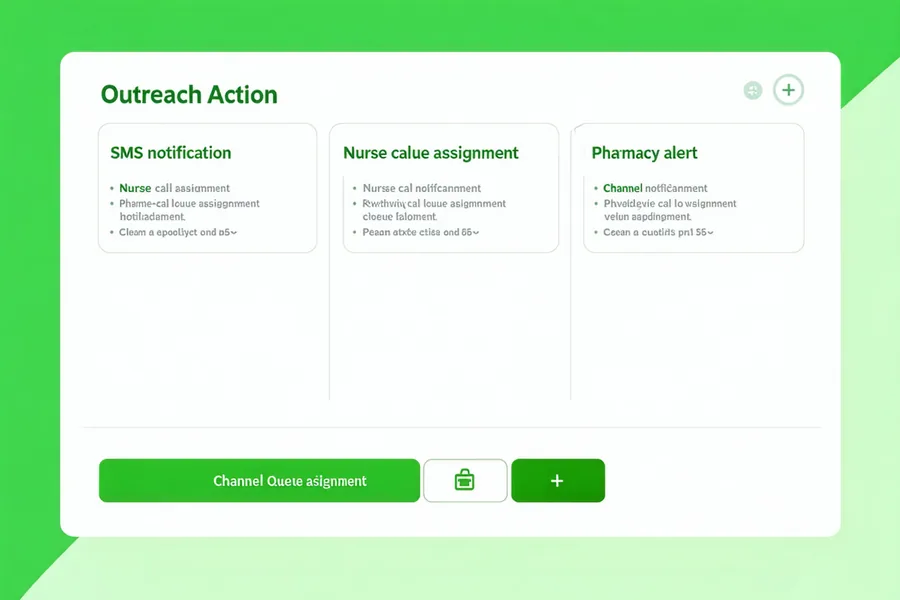
Three channels. Escalation logic. The right reach for each patient.
SMS goes directly to the patient — highest response rate for younger diabetes and hypertension populations. The nurse call queue surfaces high-risk patients to the care coordinator call list with the reason for the contact pre-populated. The pharmacy alert notifies the dispensing pharmacist at the point of refill pickup — most effective for CHF patients with refill gaps.
The care coordinator sets escalation rules once. From then on, the system fires the right channel, escalates if no response, and marks patients off the queue automatically when they respond.
What the care team sees every morning. What VBC leadership sees each week.
Care coordinators get a daily risk report — who's on the queue, what changed overnight, which interventions are pending. VBC program directors get a weekly summary: refill gap closures, appointment completions, patients moved from at-risk to engaged. Both views pull from the same data, just at different granularity.
For Population and System tier customers, the reporting dashboard includes HEDIS gap closure tracking — showing which care quality measures are on track vs. at risk for the current contract period.
Built with HIPAA controls in mind from day one
Patient data security isn't a feature we added after the fact. The architecture was designed around it from the beginning — every BAA, every encryption layer, every role-scoped access control — because we're building for health systems, not consumer apps.